

Population Matters’ Campaigns and Projects Officer, Florence Blondel, reflects on her family life in Uganda — and the changes she sees coming.

Florence with pupils in Ejirikombeni, Northern Uganda
There was a time when I would mentally count my siblings, often using my fingers — cracking the knuckles in a ritual that brought a strange, painful pleasure (one that occasionally irritates my husband). I come from a family of… well, I always have to pause and calculate. You see, my father didn’t only cohabit with my mother — with whom he had seven children — but also had children with multiple other women. The ‘family’ suspects one or two may not have been his. His own father, who had more wives and 45 children, may have inspired him.
And as if continuing a generational script, I was told that my mother had twins before she met my father. I can categorically say that my mother — whose hard-earned income from farming thankfully contributed to our education — spent most of her short life bearing children at short intervals.
A COUNTRY FULL OF CHILDREN
I am from Uganda — a beautiful, yet poorly governed and poverty-stricken country, where around 78% of the population is under 30. Located in Sub-Saharan Africa (SSA), a region projected to double its population by 2050, Uganda is known for having among the world’s highest maternal death rates, total fertility rates, and population growth rates (PGR) — with the latter two partly driving the first.
Uganda’s most recent National Population Policy acknowledges that high population growth “has been fuelled mainly by the persistently high fertility coupled with high but declining mortality.” Fertility remains high due to:
-
High unmet need for family planning
-
Low use and high discontinuation of modern contraceptives, mostly due to side effects
-
Large desired family sizes (5.4 children for men and 4.8 for women)
-
High rates of teenage pregnancy
-
Male child preference by couples and society
-
Low median age at marriage and childbearing
When my mother had her ninth and final child in 1990, the average Ugandan woman was having around seven children. Each year, about 1.3 million people are added to the population. The pyramids below (for comparison, I use the UK where I now live) speak volumes about Uganda’s youthful age structure. I now understand why, when my French husband visited for the first time in 2018, he was astonished by the number of children he saw everywhere. For me, it was a common sight: nearly half the population is under 15.
These young people — all potential parents — place immense pressure on already stretched education and health systems. The environment is not spared either: 98% of the population relies on wood fuel. (Goodbye, forests.)
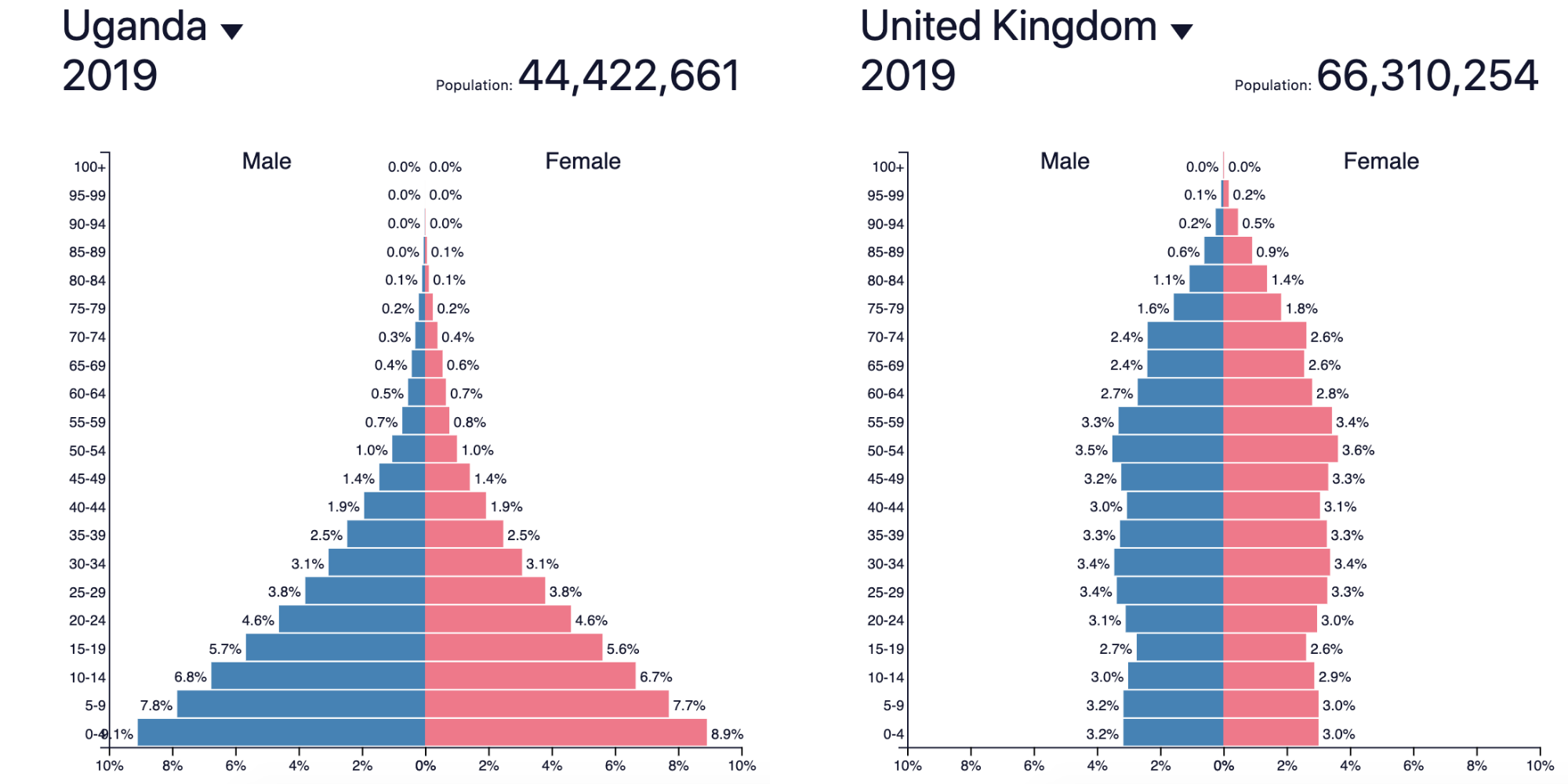
At the current 3% PGR, and without effective intervention, Uganda’s population will double in about 23 years — compared to the UK’s 0.6% rate, which would take 116 years to double.
In 1990, the UK had a population of 57 million; Uganda had 17 million. Just 29 years later, the UK added 9 million more people — while Uganda added 27 million. Of course, countries like the UK had a head start during the Industrial Revolution, but that gives me hope: back then, frequent childbearing was the norm, and women had little autonomy. But change is possible.
MY JOURNEY
My family background — and the historical treatment of women, deeply rooted in culture and religion — partly explains why I have no biological children yet. I come from a country where childbearing often begins in the early teens, and marriage almost always means children. My choice has been a quiet protest.
It’s why, as a journalist, I reported extensively on sexual and reproductive health and rights, social injustice, environmental and development issues. It’s also why I pursued a Master’s in Population and Development at the London School of Economics — and why I now work with Population Matters.


WOMEN’S AGENCY: CHANGE IS COMING
My mother gave birth to her last child — my sister — at 38, and passed away four years later, at just 42. My eldest sister, now 41, has three children; the youngest has two. At 35, I enjoy being an aunt.
In Uganda, as in much of Sub-Saharan Africa, the pressure on women to bear children persists. But education — though still marked by high dropout rates and poor quality — is slowly making a difference. More young girls and women are beginning to embrace the agency that has long been denied them.

More are marrying and having children later, and are choosing smaller families. I believe that, alongside broader social changes like lower mortality rates, if more girls are educated and stay in school longer, receive comprehensive sexuality education (including knowledge of modern contraceptives), and gain access to decent jobs — Uganda can change course.
Bangladesh offers a powerful example. Fertility there fell from 6.1 to 3.4 children per woman between 1980 and 1996 — in just 16 years. There was no coercive government programme and GDP per capita was just $270. The initiative was voluntary and ethical. Today, the country is prioritising girls’ education and aims to reach ‘replacement level’ fertility of 2.1 children per woman.
Hopefully, in the near future, there will be no more children cracking their knuckles trying to remember how many siblings they have — or wondering where each one is — because fertility nearing replacement level is possible in Uganda.
With the right policy measures, the long-term effects of rapid population growth can be mitigated. Slower population growth would bring significant social and economic benefits — especially for girls and women, who have for too long been left behind.
This article first appeared on Population Matter’s website.
 Digital Blondel
Leave a comment